


Kill Zone: The New Geometry of Modern Warfare
The Transformation of the Modern Battlefield
The battlefield has undergone a fundamental transformation since 2022.
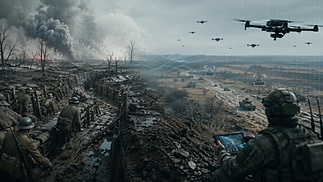
The rapid evolution of small and ultra-small unmanned aerial vehicles (UAVs)—including FPVs, bombers, and short-range wings—has reshaped modern warfare. With the integration of artificial intelligence, advanced target acquisition, and autonomous strike capabilities, these systems are no longer tactical tools—they are strategic assets.
And this trend is only accelerating.
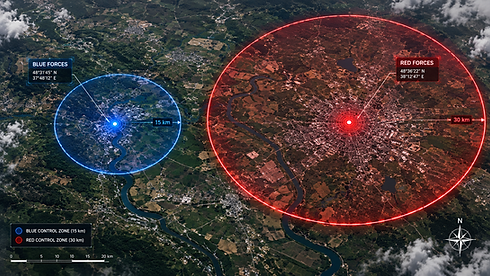
What defines advantage today is no longer just firepower or positioning—it is distance control, time to get used to the new term - KILL ZONE.
Whoever controls the effective engagement range controls the battlefield.
If our operational “kill zone” exceeds that of our adversary, we create depth, protect forward supply bases, and maintain freedom of maneuver. If not, the balance shifts — the near rear area is no longer safe, logistics become vulnerable, and critical and strategic assets can be struck at any time.
The New Geometry of Warfare
Helvetica Light is an easy-to-read font, with tall and narrow letters, that works well on almost every site.
Helvetica Light is an easy-to-read font, with tall and narrow letters, that works well on almost every site.
Dominance Through Control, Not Mass
Before the first ply is cut, the part geometry needs to be reviewed for manufacturability. Tight inside radii, abrupt thickness transitions, deep draw areas, trapped corners, and cosmetic Class A requirements all affect how the laminate can be laid up and cured. If those constraints are addressed early, production becomes more predictable.
Fiber direction is equally important. Composite materials are anisotropic, which means strength and stiffness are direction-dependent. A good laminate schedule reflects actual load paths rather than relying on a generic symmetric stack-up. This is where engineering support adds value - not by making the part more complicated, but by ensuring the structure can be manufactured without compromising performance.
Material selection also needs to balance performance and process. Carbon fiber with epoxy may be the right choice for stiffness-sensitive aerospace or robotics parts. Fiberglass may offer better cost efficiency and impact tolerance in non-critical structures. Aramid can be useful where abrasion resistance and toughness matter, but it is more difficult to cut and finish cleanly. There is no best material in isolation. There is only the best material for the load case, environment, finish requirement, and budget.
Survival in an Era of Persistent Detection
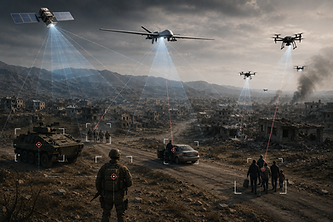
In this new reality, the battlefield leaves little room for traditional assumptions about safety or survivability.
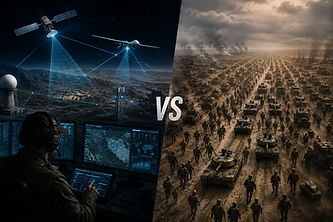
Persistent sensors, thermal detection, autonomous target tracking, and
AI-assisted strike systems are transforming the battlespace into an environment of constant exposure. Any detectable movement, heat source, or electronic signature can be rapidly identified, tracked, and engaged. Survival increasingly depends on concealment, dispersion, mobility, and rapid evacuation.
The Shrinking Window for Survival
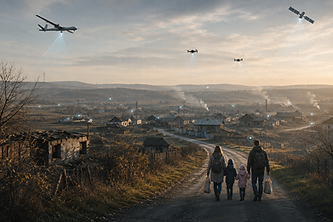
For civilians caught inside conflict zones, the risks may be even greater. The spread of autonomous systems, persistent surveillance, and high-speed targeting technologies is shrinking the margin between detection and strike, leaving increasingly little time for warning, reaction, or evacuation.
