


How to manufacture composite materials Parts

Process Discipline Defines Composite Performance
When a composite part fails in service, the root cause is often not the material system itself. It is usually a manufacturing decision - fiber orientation chosen for convenience, resin content allowed to drift, tooling that moved under heat, or a cure cycle that looked acceptable on paper but not in the laminate. That is why understanding how to manufacture composite materials starts with process discipline, not just material selection.
For engineering teams building lightweight structural parts, the goal is not simply to make a composite component. The goal is to produce a repeatable part with controlled weight, geometry, stiffness, surface quality, and long-term performance. That requires matching the manufacturing method to the application, production volume, and structural requirements from the start.
before defects and delays become expensive.
At a technical level, composite manufacturing combines reinforcement and matrix into a consolidated structure. In most industrial applications, the reinforcement is carbon fiber, fiberglass, or aramid, and the matrix is typically a thermoset resin such as epoxy, polyester, or vinyl ester. The manufacturing challenge is to place the fibers where loads demand them, fully wet them out or consolidate prepreg correctly, remove excess air and volatiles, and cure the laminate into a stable shape.
The right process depends on the part. A UAV skin, a robotic enclosure, and an automotive structural insert may all use composite materials, but they should not automatically use the same manufacturing route. High-performance low-volume parts often justify more controlled processes, while medium-volume industrial components may require faster, more economical methods.
How to manufacture composite materials in practice
Helvetica Light is an easy-to-read font, with tall and narrow letters, that works well on almost every site.
Helvetica Light is an easy-to-read font, with tall and narrow letters, that works well on almost every site.


Start with design for manufacturability
Before the first ply is cut, the part geometry needs to be reviewed for manufacturability. Tight inside radii, abrupt thickness transitions, deep draw areas, trapped corners, and cosmetic Class A requirements all affect how the laminate can be laid up and cured. If those constraints are addressed early, production becomes more predictable.
Fiber direction is equally important. Composite materials are anisotropic, which means strength and stiffness are direction-dependent. A good laminate schedule reflects actual load paths rather than relying on a generic symmetric stack-up. This is where engineering support adds value - not by making the part more complicated, but by ensuring the structure can be manufactured without compromising performance.
Material selection also needs to balance performance and process. Carbon fiber with epoxy may be the right choice for stiffness-sensitive aerospace or robotics parts. Fiberglass may offer better cost efficiency and impact tolerance in non-critical structures. Aramid can be useful where abrasion resistance and toughness matter, but it is more difficult to cut and finish cleanly. There is no best material in isolation. There is only the best material for the load case, environment, finish requirement, and budget.
Core steps in manufacturing composite parts
Tooling and mold preparation
Composite parts inherit their geometry from the tool. If the mold is dimensionally unstable, poorly finished, or thermally inconsistent, the finished part will reflect those issues. Tooling may be made from aluminum, composite, or high-temperature board materials depending on volume, cure temperature, and tolerance demands.
Mold preparation includes cleaning, release system application, and verification of surface condition. For cosmetic or aerodynamic parts, small defects in the mold can create recurring rework downstream. In production environments, mold maintenance is not a minor housekeeping task. It is part of quality control.
Ply cutting and kitting
Reinforcement must be cut accurately and labeled clearly. Whether using dry fabric or prepreg, ply orientation, sequence, and traceability matter. Misplaced or rotated plies can shift local stiffness or weaken load-bearing zones without being obvious during layup.
For repeat production, kitting reduces variation. It also shortens cycle time and improves accountability on the shop floor. In more demanding sectors, that level of process control is expected, not optional.
Layup and core integration
Layup is where the laminate architecture is built. Fabrics or prepreg plies are placed into the tool in a defined sequence, often with sandwich cores, inserts, or local reinforcements added as required. Care is needed around corners, overlaps, ply drops, and transitions to avoid bridging, wrinkles, or resin-rich pockets.
If the part uses foam or honeycomb core, edge treatment and bonding strategy become critical. Poor core integration can reduce compression strength, create local print-through, or lead to debonding in service. Lightweight design works only when the interface between skins and core is properly managed.
Consolidation and vacuum bagging
For many high-performance thermoset processes, vacuum bagging is used to compact the laminate, remove entrapped air, and support resin flow or prepreg consolidation. A typical bagging stack may include peel ply, perforated release film, breather, sealant tape, and vacuum film, though the exact arrangement depends on the process.
This stage is often underestimated. A leak, blocked vacuum path, or incorrect consumable stack can create porosity, dry areas, or thickness variation. Good bagging practice is one of the clearest differences between a part that looks acceptable and a part that performs consistently.
Curing
Curing transforms the resin from a workable state into a structural matrix. Depending on the material system, this may happen at room temperature, in an oven, under vacuum, or in an autoclave. Cure cycles need to be validated for ramp rate, dwell, peak temperature, and sometimes pressure.
More heat is not automatically better. Excessive exotherm can distort the laminate or degrade resin properties, while under-cure can reduce mechanical performance and thermal stability. Thick sections, mixed materials, and embedded hardware all complicate cure behavior, which is why process monitoring matters.
Demolding, trimming, and finishing
After cure, the part is demolded, trimmed, machined, inspected, and finished as needed. This may include CNC trimming, bonding operations, surface preparation, filling, priming, painting, or assembly integration. Finishing should be planned from the beginning because trim allowances, tooling split lines, and fixture points all affect downstream efficiency.
If tight tolerances are required, secondary machining and inspection need to be built into the route. Composite parts do not become precision parts by accident.

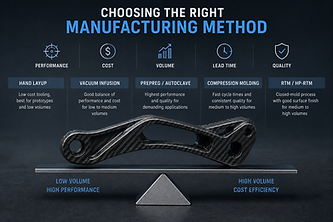
Choosing the right manufacturing method
If the question is how to manufacture composite materials efficiently, the answer usually comes down to selecting the right process for the part and volume.
Hand layup remains useful for prototypes, large parts, and lower-volume applications where flexibility matters more than speed. It is cost-effective on tooling, but quality depends heavily on technician skill and process discipline.
Vacuum infusion offers better resin control and lower void content than basic wet layup for many dry-fiber applications. It can be a strong option for larger structures where one-sided tooling is preferred, though resin flow design and permeability need careful planning.
Prepreg layup with oven or autoclave curing is often chosen for higher-performance parts that demand tight fiber volume control, better surface quality, and stronger repeatability. It comes with higher material storage requirements, stricter handling rules, and more expensive processing.
Compression molding and RTM can make sense for repeatable higher-volume production, especially when cycle time and dimensional consistency are key. But those methods require greater upfront investment in tooling and process development. For some programs, that is justified. For others, it creates cost without enough return.
Quality control is part of manufacturing,
not a final check
A reliable composite process includes inspection throughout production. Material traceability, environmental controls, vacuum checks, cure records, in-process signoffs, and dimensional inspection all reduce risk before the part reaches final acceptance.
Depending on the application, quality control may also include ultrasonic inspection, tap testing, weight verification, resin content checks, or destructive coupon validation. The required level of control depends on the sector, but in aerospace, UAV, robotics, and defense-adjacent work, documentation and repeatability carry real weight.
This is also where an experienced manufacturing partner can prevent expensive iteration. At Compositech LTD, the advantage of combining design support, prototyping, production, finishing, and repair is that manufacturability issues are identified earlier, before they become schedule problems or field failures.


Common manufacturing mistakes to avoid
The most frequent issues are rarely dramatic. They are cumulative. Inconsistent ply placement, poorly defined work instructions, uncontrolled humidity, rushed bagging, incorrect trim references, and weak inspection gates all create variability that shows up later as weight drift, cosmetic defects, or structural inconsistency.
Another common mistake is treating prototype methods as production methods. A process that works for five parts may not hold tolerance, cycle time, or quality targets at fifty or five hundred. Scaling composite manufacturing requires more than buying more material. It requires process validation, stable tooling, and documented controls.
For technically demanding parts, the best manufacturing strategy is usually the one that balances structural performance, repeatability, and realistic production economics. Pushing too far toward low cost can create rework and reliability risk. Overengineering the process can make the part commercially unworkable. The right answer sits in the middle, guided by the application.
Composite manufacturing rewards discipline. If the design, tooling, layup, cure, and inspection strategy are aligned, you get the real advantage of composites - lightweight parts with tailored performance and dependable repeatability. That is the standard worth building around.
